
Chasing the Shadow: From Spain to Luxor and Beyond
Eclipse chasing begins years before the sky goes dark. It begins with an ephemeris, a centerline, a weather history, a horizon, and the uneasy knowledge that a single cloud can erase a journey planned to the second.
That tension is part of the appeal. Celestial mechanics predicts the Moon’s shadow with extraordinary precision, yet the experience remains radically local. The geometry is global; totality happens to one observer, in one place, under one atmosphere.
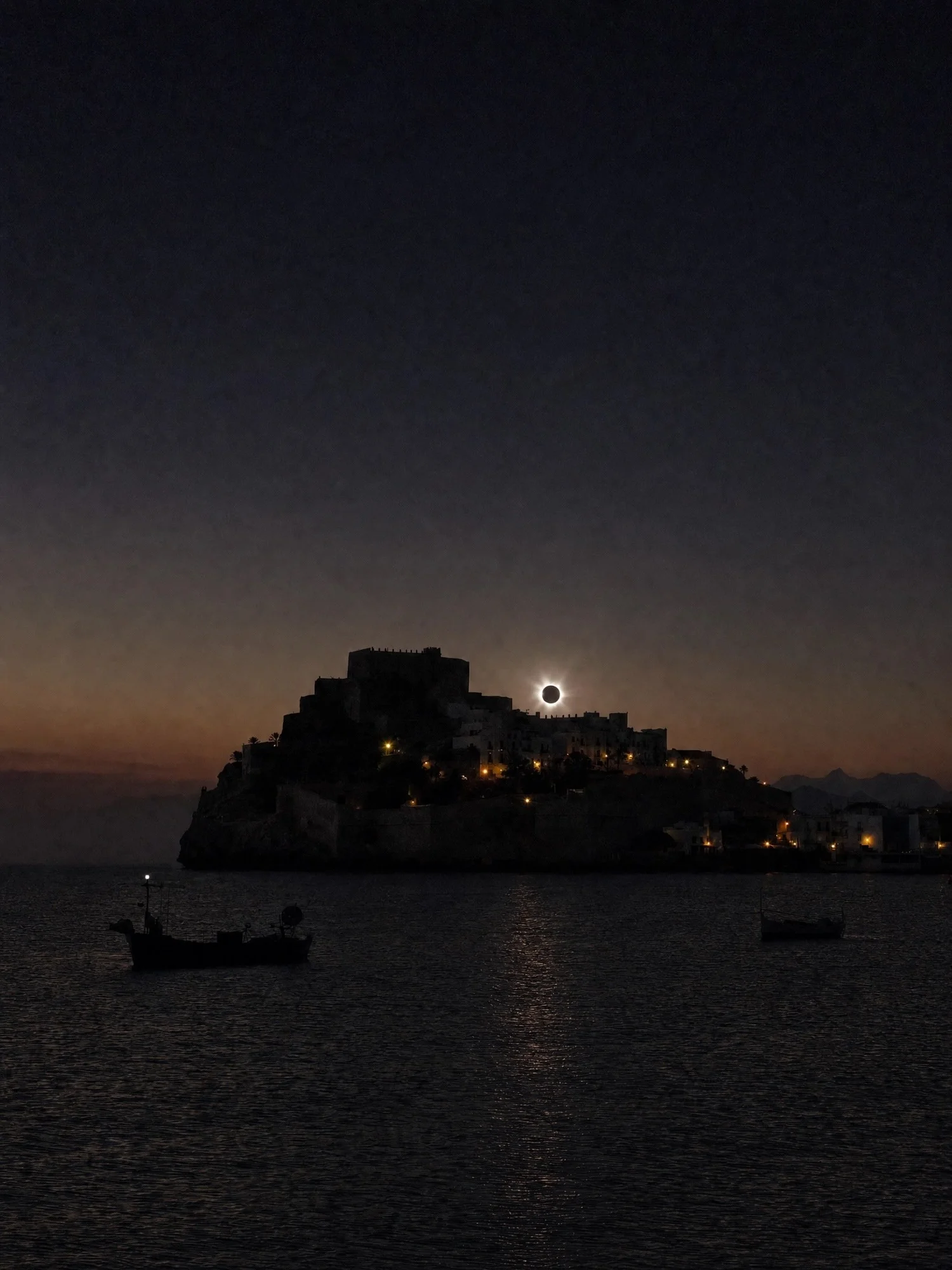
My photograph from the 12 August 2026 eclipse in Spain holds the instant when preparation gives way to perception. The corona appears around the dark lunar disk above the silhouette of a coastal town. The image is astronomical, but the memory is human: changing light, a darkening horizon, and a familiar landscape briefly made strange.
The next long shadow arrives on 2 August 2027. Totality follows a different route from 2026, crossing southern Spain and North Africa before the path reaches Luxor in Egypt. NASA’s eclipse catalog gives a maximum totality of 6 minutes 23 seconds along the path, making this one of the defining observing opportunities of the decade. The route itself joins astronomical time to archaeological time: a moving shadow over landscapes built to endure.
On 22 July 2028, another total eclipse begins over the Indian Ocean, crosses Australia, then reaches New Zealand before ending over the Pacific. Its maximum totality reaches 5 minutes 10 seconds. Australia offers the broad landfall; the later path turns planning toward coastlines, weather, access, and the changing altitude of the Sun.
Maps can make eclipse chasing look solved. They are only the first layer. The practical map adds cloud climatology, mobility, road access, foreground, equipment, backup locations, and the discipline to abandon a beautiful composition when the sky demands it.
The reward is not possession of a rare event. It is a brief alignment that makes scale visible: the Moon close enough to cover the Sun, the observer inside a narrow moving shadow, and a photograph trying to hold a few minutes that cannot be repeated.
Solar safety: Except during the brief total phase of a total solar eclipse, never look directly at the Sun without certified eclipse viewers or a properly front-mounted solar filter. Camera and telescope optics also require purpose-built solar filtration. Eye protection must be replaced the instant totality ends; the returning photosphere can injure the eye without pain. Follow current NASA and American Astronomical Society guidance.
NASA eclipse path catalog:
https://eclipse.gsfc.nasa.gov/SEpath/SEpath.html
NASA data for 2 August 2027:
https://eclipse.gsfc.nasa.gov/SEsearch/SEdata.php?Ecl=20270802
NASA data for 22 July 2028:
https://eclipse.gsfc.nasa.gov/SEsearch/SEdata.php?Ecl=20280722
NASA eclipse safety:
https://science.nasa.gov/eclipses/safety/
Hero caption: Totality over the Spanish coast, photographed by Rafeed Alkawadri during the 12 August 2026 eclipse.
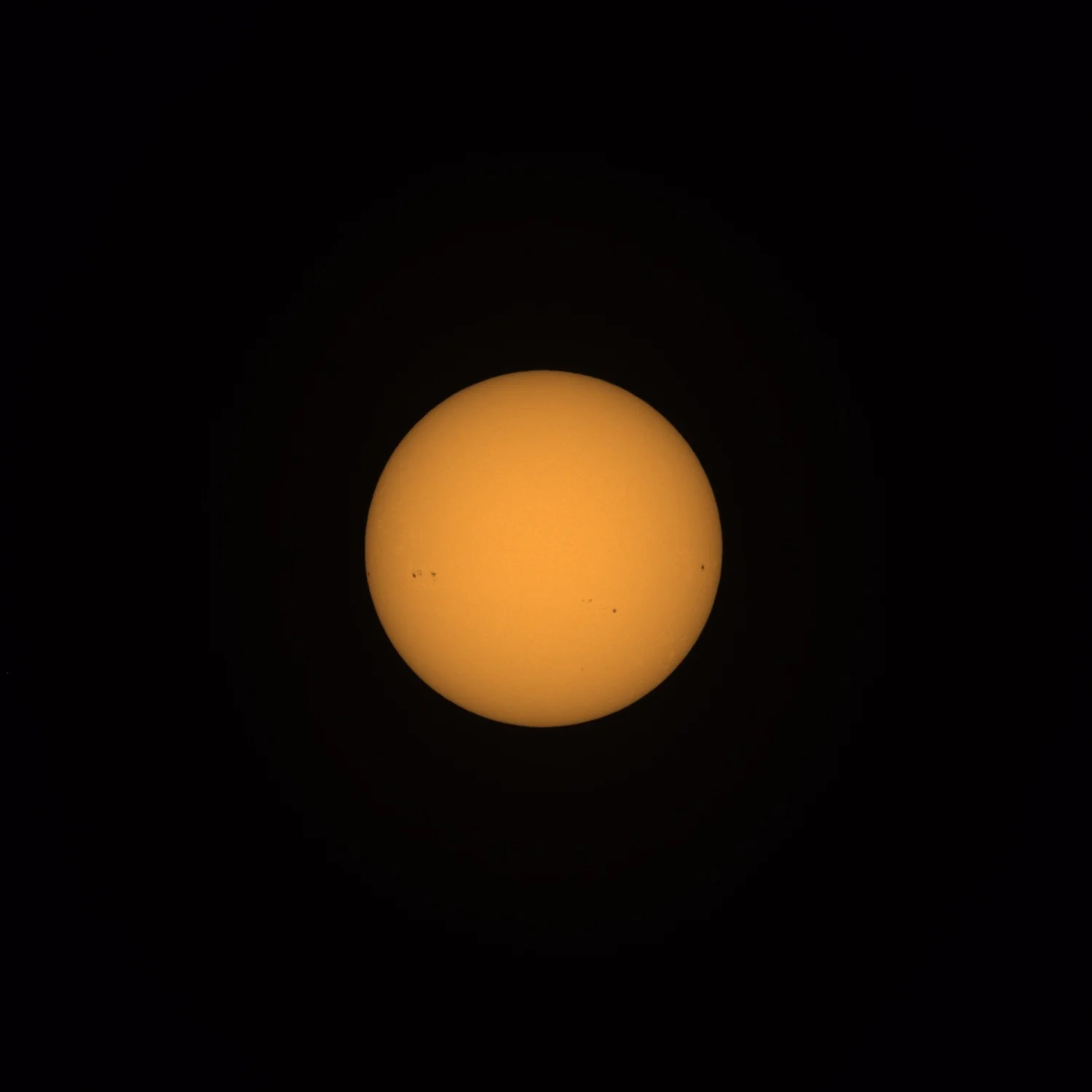
Filtered-solar-disk caption: Filtered solar disk from the Spain eclipse observing series, with several sunspot groups visible. Photograph by Rafeed Alkawadri.
2027 map caption: Global geometry and path of totality for the 2 August 2027 total solar eclipse across southern Spain, North Africa, and the Middle East. Eclipse predictions by Fred Espenak, NASA’s GSFC; reproduced with NASA’s requested acknowledgment. The point of greatest eclipse lies in Egypt, and the figure lists a maximum duration of approximately 6 minutes 23 seconds.
2028 map caption: Global geometry and path of totality for the 22 July 2028 total solar eclipse across the Indian Ocean, Australia, and New Zealand. Eclipse predictions by Fred Espenak, NASA’s GSFC; reproduced with NASA’s requested acknowledgment. The data block reports a maximum duration of about 5 minutes 10 seconds.
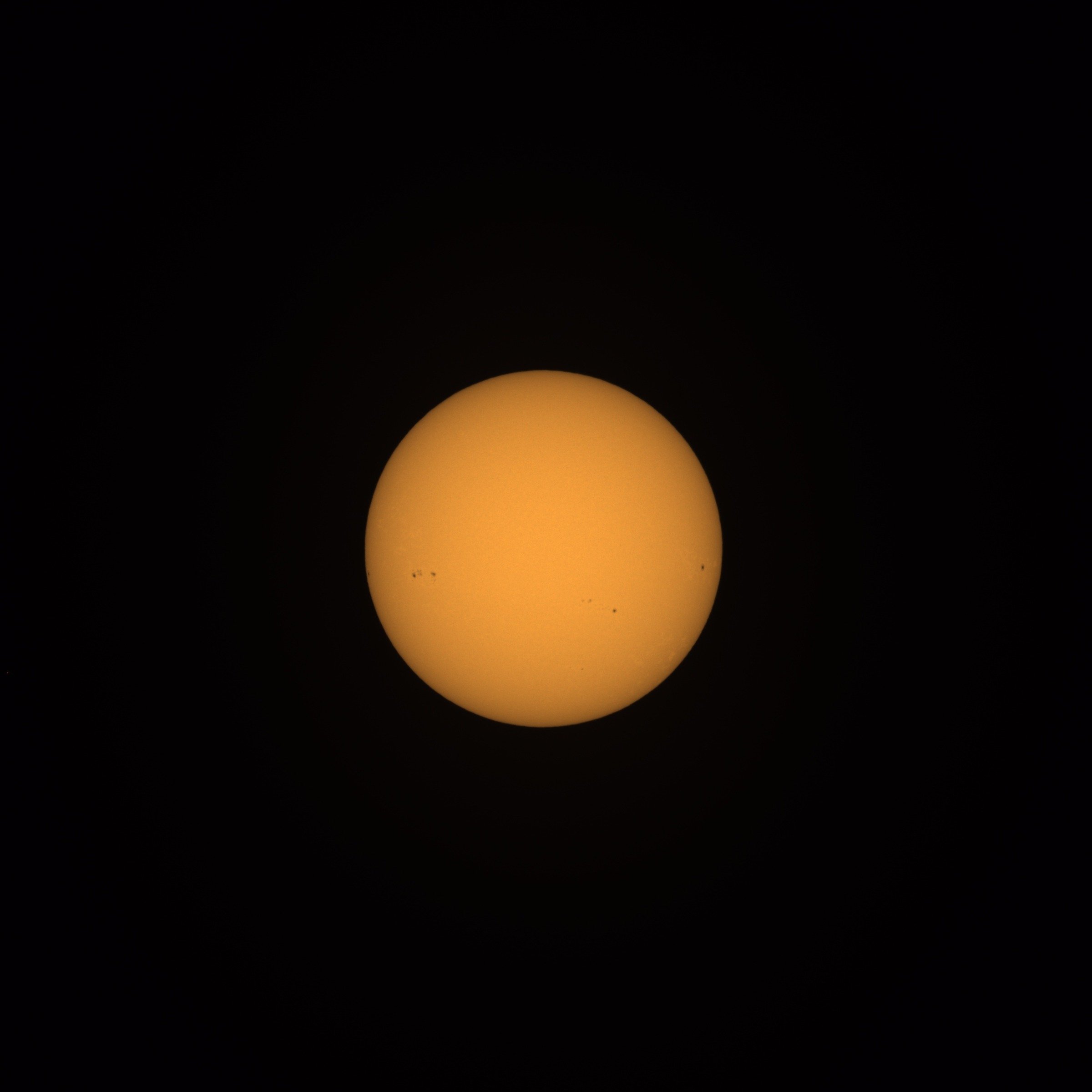
Filtered solar disk from the Spain eclipse observing series, with several sunspot groups visible. Photograph by Rafeed Alkawadri. Except during totality, certified eye and equipment filtration is essential.
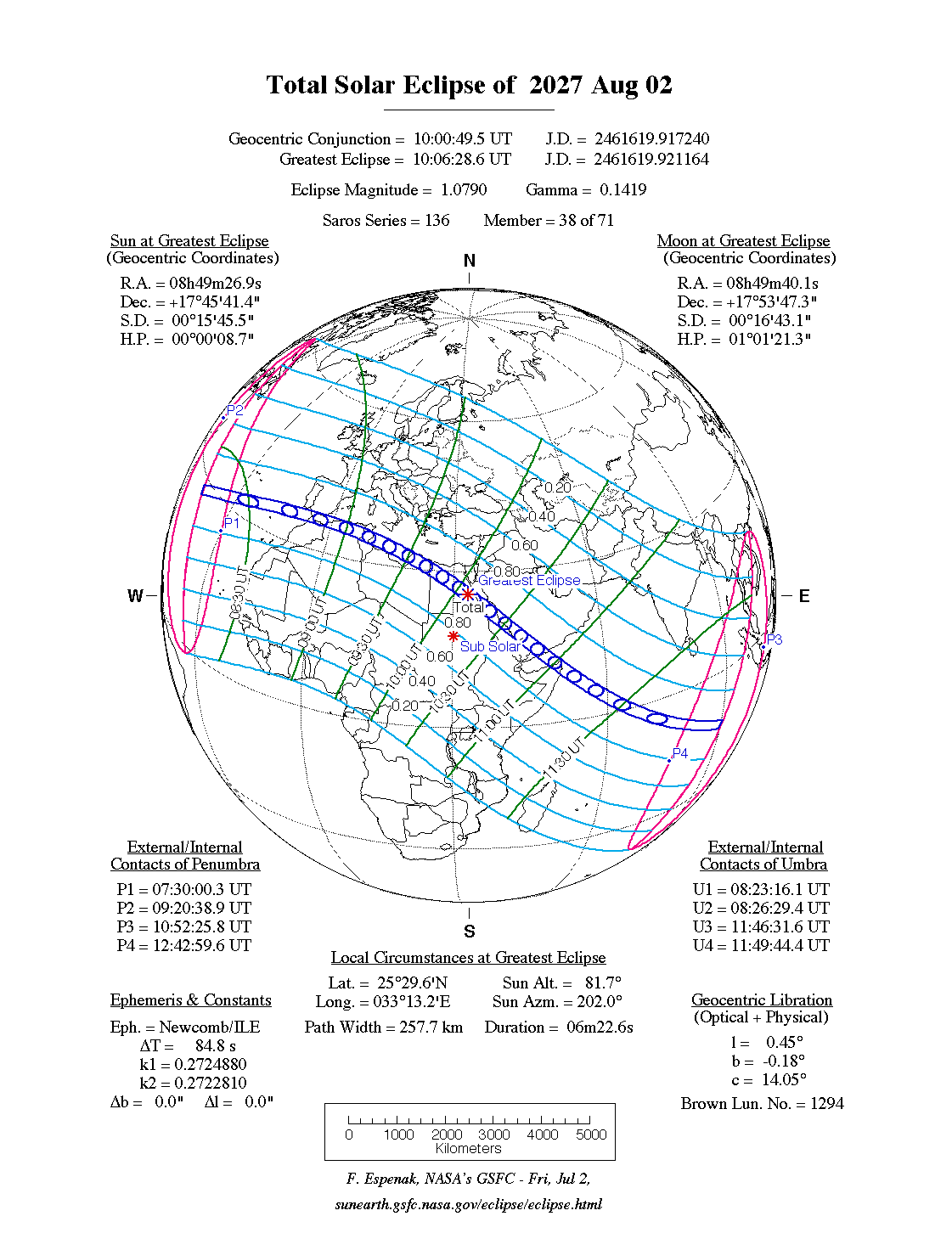
Global geometry and path of totality for the 2 August 2027 total solar eclipse across southern Spain, North Africa, and the Middle East. Eclipse predictions by Fred Espenak, NASA’s GSFC; reproduced with NASA’s requested acknowledgment. Maximum totality is approximately 6 minutes 23 seconds.
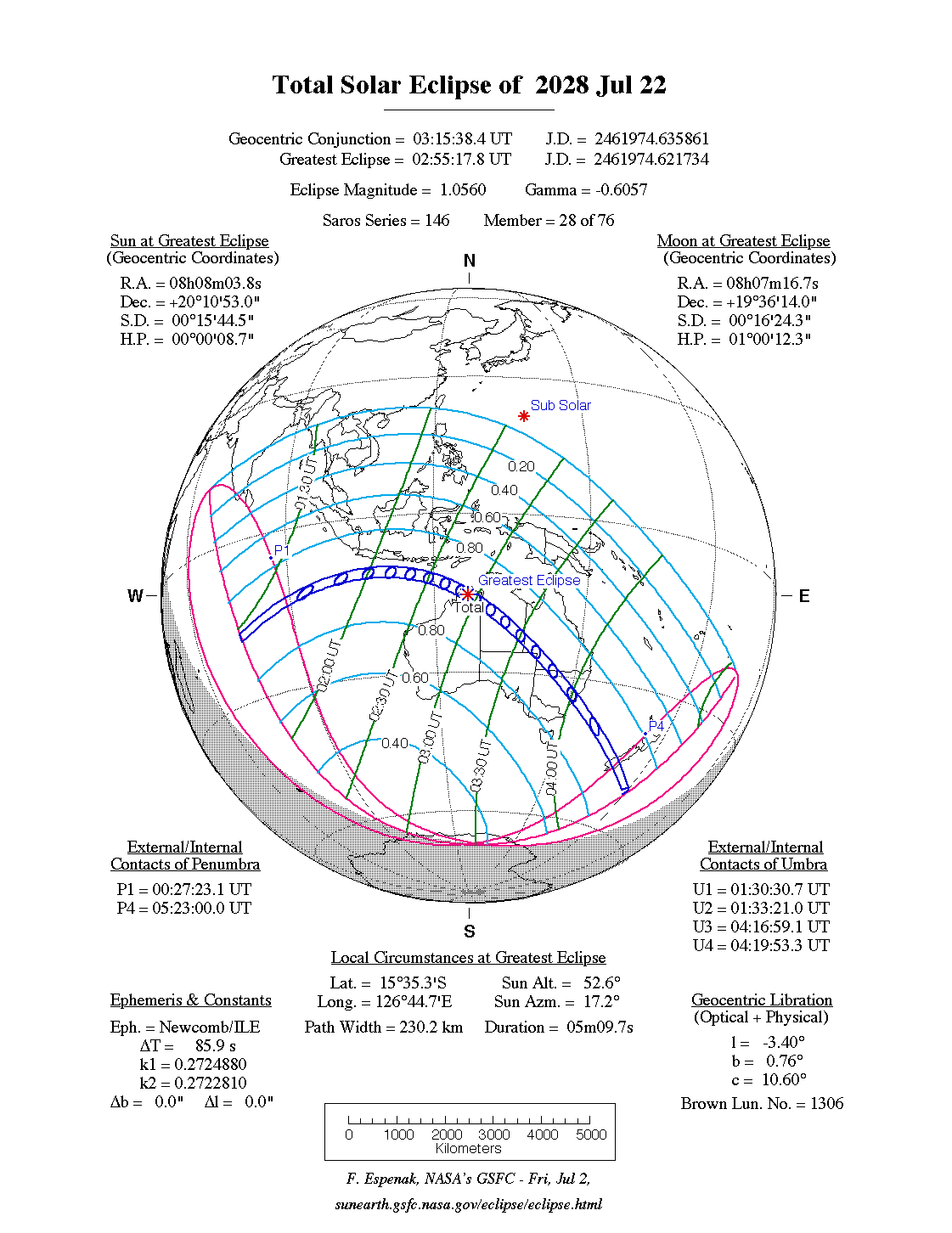
Global geometry and path of totality for the 22 July 2028 total solar eclipse across the Indian Ocean, Australia, and New Zealand. Eclipse predictions by Fred Espenak, NASA’s GSFC; reproduced with NASA’s requested acknowledgment. Maximum totality is about 5 minutes 10 seconds.
Plan the next shadow
Map description. The 2 August 2027 path of totality begins over the Atlantic, crosses southern Spain and Gibraltar, then tracks east across North Africa through Morocco, Algeria, Tunisia, Libya, and Egypt—including the Luxor region near the longest totality—before continuing across the Red Sea and Arabian Peninsula toward the Indian Ocean.
Map description. The 22 July 2028 path of totality begins over the Indian Ocean, reaches northern Australia near the Kimberley and continues southeast across the continent, passing through or near central and eastern population corridors before moving over the Tasman Sea toward New Zealand. The longest-duration region lies near the northwestern Australian portion of the track.