The Work No One Sees
Craftsmanship, Love, and the Art of Science
What a transition at Apple, a hidden signature inside the Macintosh, and the architecture of the human brain can teach us about work made in service to others.
By Rafeed Alkawadri, MD
September 1, 2026
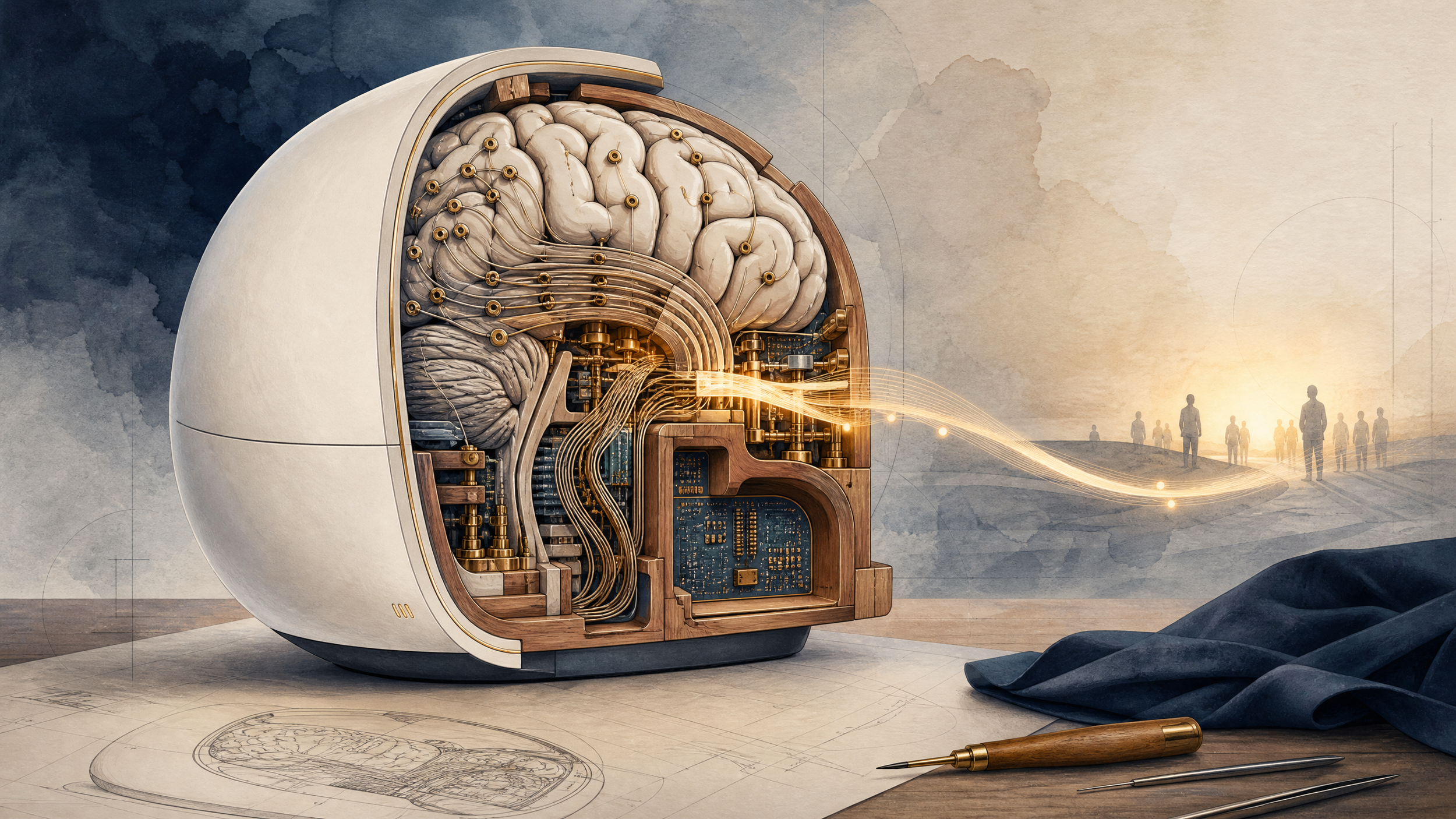
The work no one sees. Scientific craft lives in the hidden architecture of methods, signals, figures, and decisions—and finds its meaning in the people it ultimately reaches.
On August 31, 2026, Tim Cook completed his final day as Apple’s chief executive. On September 1, John Ternus assumed the role, while Cook became executive chairman of Apple’s board.1 The date closes a remarkable chapter, but this is not an essay about corporate succession. It is about stewardship: what it means to inherit a standard that seems impossible to meet, then carry its essential principles forward without merely imitating the person who came before.
Steve Jobs left very large shoes. Cook did not try to become another Jobs. In my view, his achievement was subtler and perhaps more difficult: he preserved Apple’s loyalty to detail, disciplined focus, and insistence on coherent products, while translating a famously abrasive culture of perfection into a steadier form of leadership. The record will rightly include products, services, Apple silicon, privacy, accessibility, environmental commitments, and extraordinary growth.1 Yet leadership is not only what an organization produces. It is also the character with which the work is carried from one generation to the next.
That transition returned me to something Jobs said in 2007—not about market share, valuation, or personal acclaim, but about making:
“One of the ways that I believe people express their appreciation to the rest of humanity is to make something wonderful and put it out there.”
He continued: “Somehow, in the act of making something with a great deal of care and love, something’s transmitted there.” —Steve Jobs2
The power of those words is that they shift the center of gravity. The maker may never meet the person who uses the object. The scientist may never meet the reader who learns from a figure. The physician-scientist may never meet the patient whose care is changed years later by an experiment, an algorithm, a negative result honestly reported, or a method described well enough to reproduce. Still, something is transmitted: not merely information, but care made visible through form.
The Hidden Side of the Cabinet
Jobs’s philosophy of craft began long before Apple. He recalled that his adoptive father, Paul Jobs, would not use poor wood on the back of a cabinet simply because no one was likely to see it. Nor would he build the hidden side of a fence less carefully than the front. “For you to sleep well at night,” Jobs later said, “the aesthetic, the quality, has to be carried all the way through.”3
Years later, while developing the Macintosh, Jobs criticized the appearance of its internal circuit board. The lines and chips had to be arranged elegantly even though the customer would ordinarily never see them. When the machine was complete, the Macintosh team’s signatures were engraved inside its case. “Real artists sign their work,” Jobs told them.4
The detail I find most compelling is not the signature itself. It is the decision to make the invisible worthy of a signature.
What the audience sees — and the work that makes it trustworthy
A clean scientific figure — Careful preprocessing, artifact control, appropriate scales, and honest uncertainty.
A concise result — Years of failed attempts, controls, revisions, and disciplined interpretation.
A clinical recommendation — Patient histories, risk–benefit judgment, team discussion, and responsibility for consequences.
A polished grant or manuscript — Clear thinking, coherent structure, reproducible methods, and respect for the reviewer’s time.
This is where Apple’s story overlaps with our own work in human brain mapping.
Science Is Not Made Less Rigorous by Becoming Art
I have long approached science as an art—and medicine as an art. That statement can sound ornamental, as if “art” were the decorative layer added after the serious work is done. I mean almost the opposite.
To treat science as an art is to refuse carelessness at every level: in the question, the experiment, the signal, the code, the inference, the figure, the sentence, and the acknowledgment of what remains unknown. It is to understand that rigor and beauty are not enemies. At their best, they converge in clarity.
A beautiful figure cannot rescue weak evidence. A clever graphic cannot compensate for an underpowered study, an untested assumption, or a misleading axis. But a well-made figure can reveal the intellectual structure of strong work. It can show the reader what matters, what is uncertain, and where the conclusion ends. In that sense, visual discipline is not cosmetic. It is ethical.
This may explain why experienced scientists often look first at the figures when they open a paper or review a grant. I once wondered whether that placed too much emphasis on presentation. I understand it differently now. A figure is often the most compressed expression of the author’s habits of mind. Is the comparison fair? Are the labels exact? Are the data allowed to breathe? Has complexity been clarified—or concealed?
The surface does not prove the substance. Yet a disorderly surface can warn us that the hidden joinery may also have been neglected.
The Proper Measure of Scientific Ambition
Science offers many legitimate rewards: discovery, recognition, authorship, promotion, influence, and the satisfaction of solving a difficult problem. Mathematics carries its own abstract beauty; it remains one of my favorite subjects precisely because a compact structure can illuminate something immense. These rewards are real, and there is no virtue in pretending otherwise.
But they are not enough.
If the work ultimately turns only toward the self—toward personal fame, visibility, or victory—then, in my opinion, much of its value is lost. The deeper measure is whether it enlarges what another person can understand, endure, decide, or hope for. In medicine, that “other person” is never theoretical. It is the patient whose seizures remain uncontrolled, the family waiting for an explanation, the trainee learning how to ask a better question, and the colleague trying to build upon what we leave behind.
At the Human Brain Mapping Program, our public aim is “to demystify the brain one-millisecond at a time.”5 The instruments may be EEG, intracranial EEG, MEG, stimulation, imaging, or computation. The immediate objects may be voltages, networks, oscillations, and maps. Yet the destination is human: more faithful models of cognition and disease, safer and more informative clinical pathways, and ultimately better care.
The art lies not in making those aims grander than they are. It lies in making every intermediate step worthy of them.
Art, Love, and the Human Brain
To me, art—like love—is among the fullest manifestations of the human. It asks us to imagine what is not yet present, to hold another person in mind, to choose among possibilities, to revise, to restrain, and to care whether the final form is worthy of its recipient.
It is tempting to place all of this in the prefrontal cortex: that remarkable expanse associated with planning, evaluation, cognitive control, and the organization of behavior across time. The human evolutionary story, however, is richer than a single region. Modern cognition emerged through changes in brain size, development, microstructure, and—crucially—connectivity across distributed systems.6 Creativity likewise appears to depend on dynamic cooperation among networks involved in spontaneous thought, attention, memory, and executive evaluation; prefrontal regions participate, but never alone.7 Love, too, recruits overlapping systems for attachment, reward, salience, empathy, and social cognition, with different patterns depending on whom or what we love.8
That does not weaken the metaphor. It makes it more beautiful.
The ultimate human expression may not reside in one anatomical summit. It may arise from relationship: one region speaking to another, imagination meeting discipline, feeling meeting judgment, self meeting other. The brain creates through coordination. So do laboratories. So does medicine. So does a life.
Carrying the Craft Forward
Jobs wanted to “make a dent in the universe,” and he most likely did.
There is a quieter biographical thread in Jobs’s story that has always resonated with me. He was born in San Francisco, the biological son of Abdulfattah Jandali, who grew up in Homs, Syria, and Joanne Schieble. He was adopted and raised by Paul and Clara Jobs, whom he regarded unequivocally as his parents.9 Heritage does not explain genius, and ancestry should never be recruited into mythology. Still, for those of us who know Homs not as an abstraction but as part of a cultural and personal landscape, the connection brings the story a little closer.
Cook’s achievement was not to reproduce Jobs’s personality. It was to safeguard a culture of making while allowing leadership to take a different human form. That, too, is a kind of art: knowing what must remain, what must change, and what must be entrusted to the next person.
On September 1, a new era began at Apple. In science, such transitions happen more quietly: a trainee becomes a mentor; a method outlives its inventor; a dataset is reanalyzed by people we will never meet; a figure carries an idea across specialties, languages, and years.
The question is not whether our names remain visible on the outside.
The question is whether the work on the inside was made with enough rigor, clarity, and love to deserve a signature.
References
Apple Newsroom. Tim Cook to become Apple Executive Chairman; John Ternus to become Apple CEO. April 20, 2026.
Steve Jobs Archive. Make Something Wonderful: Steve Jobs in His Own Words.
The Next Web. Steve Jobs’ obsession with the quality of the things unseen.
CNBC. How Steve Jobs developed his design philosophy for Apple. May 10, 2018.
A natural history of the human mind: tracing evolutionary changes in brain and cognition. PubMed Central.
Driving the brain towards creativity and intelligence: A network control theory analysis. PubMed Central.
Six types of loves differentially recruit reward and social cognition brain areas. Cerebral Cortex, 2024.
USA Today. Steve Jobs’ biological father was a Syrian migrant. November 16, 2015.