Beyond Accuracy: What Clinical AI in Neurology Must Get Right
Alkawadri R, Hillis JM, Asano E. Editorial: Exploring the future of neurology: how AI is revolutionizing diagnoses, treatments, and beyond. Frontiers in Neurology. 2025;16:1556510. PMID: 39974367.
Artificial intelligence is already changing how neurological data can be organized, interpreted, and communicated. The harder question is not whether a model can perform well on a benchmark, but whether its performance remains useful when the cases are rare, the data are messy, and the cost of error is uneven.
That distinction is central to the 2025 Frontiers in Neurology editorial by Alkawadri and colleagues. In imbalanced clinical datasets, accuracy alone can conceal failure in the minority class—the patients or events a model may most need to recognize. Precision, recall, F1 score, and area under the curve therefore belong beside accuracy, while class weighting, data augmentation, transfer learning, federated learning, and careful retraining can help address less-common cases and shifting patterns.
Neurological prediction also lives in time. Seizures, deterioration, and outcomes are shaped by biological, behavioral, and social variables; rare high-impact events may follow fat-tailed rather than tidy distributions. Models must be tested for robustness to those realities rather than optimized only for an average case.
The collection introduced by the editorial spans seizure detection and forecasting, neurodegenerative disease, rehabilitation, neuroimaging, transcranial Doppler, and acute neurological deterioration. Its broader argument is deliberately collaborative: AI should extend clinical judgment and reveal patterns that conventional methods miss, while physicians preserve context, accountability, and the definition of meaningful outcomes.
Full editorial:
https://doi.org/10.3389/fneur.2025.1556510
Original article collection:
https://www.frontiersin.org/research-topics/57346/exploring-the-future-of-neurology-how-ai-is-revolutionizing-diagnoses-treatments-and-beyond
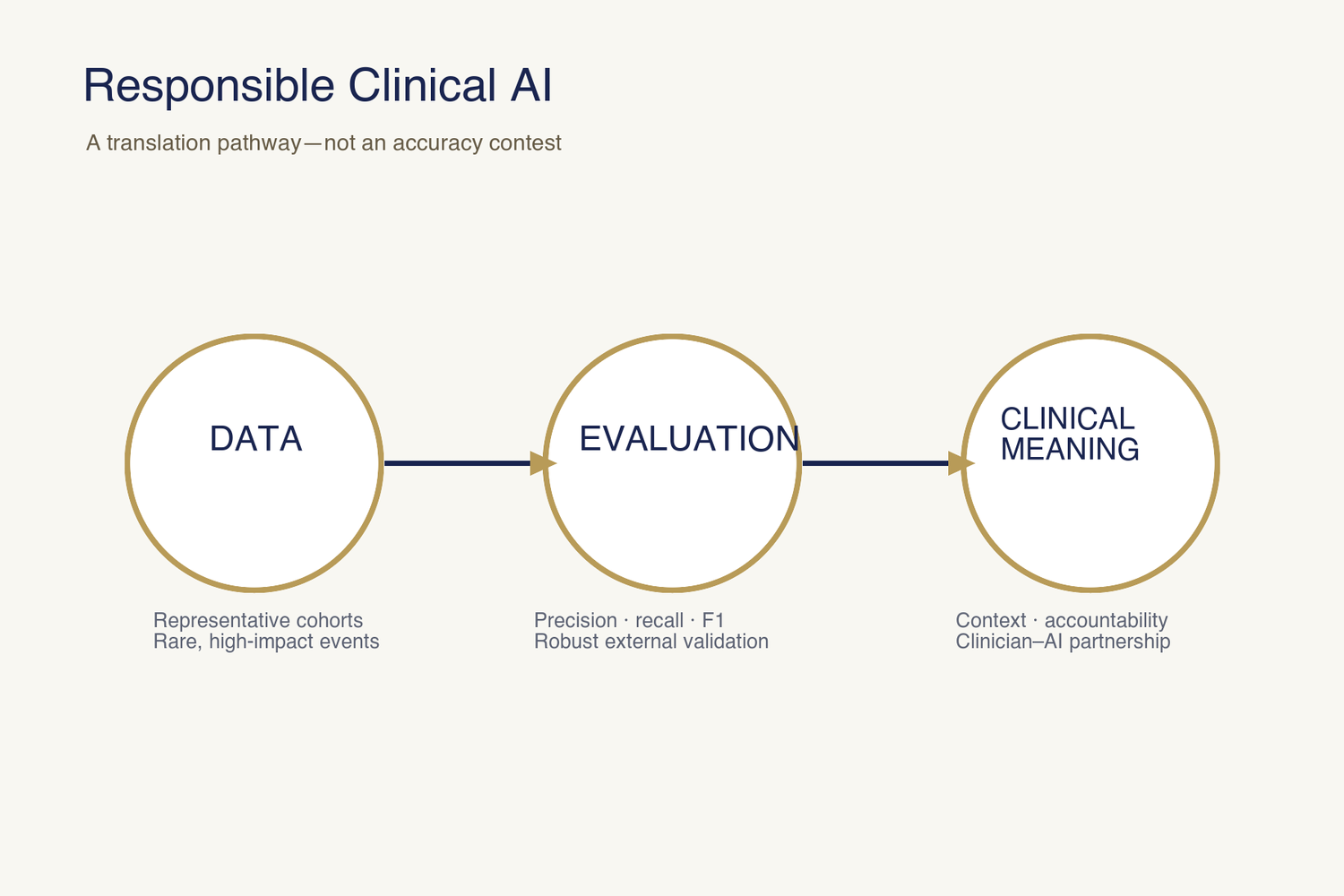
Figure: Responsible clinical AI is a pathway from representative data through meaningful evaluation to clinical context and accountability. Human Brain Mapping original visual.